
Automotive Tech & Experiments

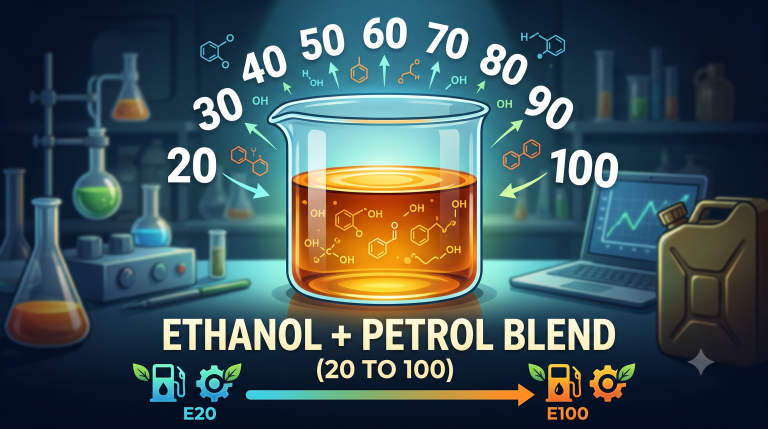
Can a Standard Motorcycle Run on 100% Pure Ethanol? (E20 to E100 Experiment)

With the national rollout of E20 petrol (80% petrol, 20% ethanol), riders everywhere are asking: How much ethanol can a normal motorcycle actually handle? We took a standard carburetor motorcycle and pushed it from E20 to 100% pure lab-grade ethanol to find out.

Ethanol Blend Performance Summary

Experimental results on stock carburetor engine settings.

Fuel Blend Ethanol % Engine Start Idling Stability Throttle Response
E20 20% Instant Perfect Normal Baseline
E40 40% Instant Stable Normal / Mildly Sluggish
E60 60% Instant Stable Punchy / Loud
E90 90% Quick Slightly Unstable Acceptable
E100 100% Takes Effort Stalls at Idle Requires Feathering

The Testing Setup: Eliminating Variables

Testing ethanol compatibility requires absolute purity in the fuel line. Pouring ethanol directly into a motorcycle’s standard fuel tank mixes it with residual petrol, skewing the test results.

Controls Applied for Test Accuracy

  • Engine Selection: We chose a carburetor-based engine over Fuel Injection (FI). Carburetors rely on gravity feed, allowing a clean, temporary fuel line setup.
  • Draining Residual Fuel: Before each new blend, the carburetor bowl was completely drained and run dry.
  • Pure Ethanol Grade: We used 99.9% pure laboratory-grade anhydrous ethanol to prevent water contamination during mixing.

Step-by-Step Blend Test Results

01

E40 Petrol (40% Ethanol, 60% Petrol)

Mixed 400 ml of E20 petrol with 133 ml of pure ethanol.

Result: Started on the first kick. Riding felt virtually identical to standard E20 fuel, with smooth throttle response.

02

E60 Petrol (60% Ethanol, 40% Petrol)

Combined equal parts E20 petrol (400 ml) and pure ethanol (400 ml).

Result: Instant start. Surprisingly, throttle pull gave a noticeable "punch," and the exhaust note became slightly louder and crisp.

03

E90 Petrol (90% Ethanol, 10% Petrol)

Mixed 100 ml of E20 petrol with 700 ml of pure ethanol.

Result: The bike ran and was rideable, but low-end idling became slightly unstable, stalling once or twice when stopped.

04

100% Pure Ethanol (E100)

Poured 100% pure lab-grade ethanol directly into the fuel line—zero petrol added.

Result: The exhaust smell shifted completely to a sweet, alcohol aroma. The motorcycle was rideable but required continuous throttle feathering to prevent stalling due to jetting differences.

How Does a Engine Run on Pure Alcohol?

An internal combustion engine operates on a simple principle: combustion. As long as a volatile fuel vaporizes, mixes with oxygen, and ignites via a spark plug, the piston moves—whether the fuel is petrol, diesel, CNG, or ethanol.

"Ethanol contains less energy density per liter than petrol and requires significantly more fuel volume per unit of air to burn properly. Without re-jetting carburetors or remapping ECUs, high-ethanol blends cause standard engines to run lean."

1. Water Absorption

Ethanol is hygroscopic—it attracts water from air. Rain moisture causes phase separation, leading to line corrosion and clogged jets.

2. Air-Fuel Ratio

Petrol burns at 14.7:1 air-fuel ratio, while ethanol requires 9:1. Uncalibrated engines run hotter and lean on high ethanol blends.

3. Rubber Degradation

Standard rubber fuel lines, O-rings, and gaskets degrade or harden rapidly under high alcohol exposure.

Frequently Asked Questions

Will E20 petrol ruin my old motorcycle engine immediately?

No. E20 fuel will not break your engine immediately. However, moisture accumulation over time can cause internal tank rust or rubber hose degradation on non-compatible models.

Can I run my bike on 100% ethanol permanently?

Not without modifications. Safe long-term use of E100 requires larger carburetor jets (or remapped ECU fuel injectors), alcohol-resistant fuel lines, and anti-corrosive tank coatings.