
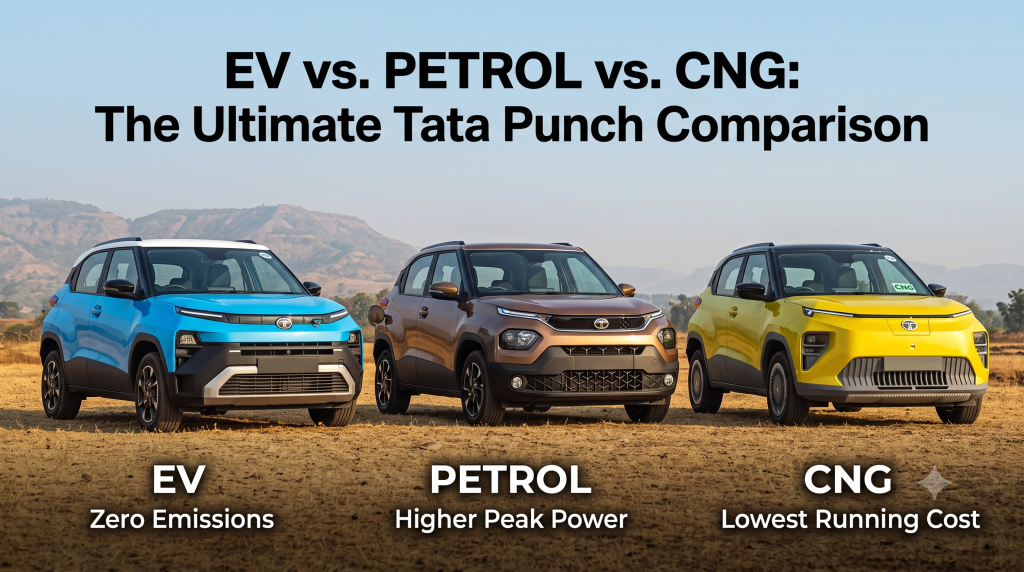
Tata Punch EV vs Petrol vs CNG: Ultimate Ownership & Cost Comparison (2026 Guide)
Fuel prices continue to climb, leaving car buyers in a major dilemma: Should you buy a conventional Petrol car, opt for factory-fitted CNG, or make the leap to an Electric Vehicle (EV)?
At first glance, cars like the Tata Punch Petrol and Tata Punch EV look almost identical. However, under the skin, their upfront costs, running expenses, technology, and maintenance requirements couldn't be more different.
In this deep-dive guide, we break down the real-world numbers, initial pricing gaps, 5-year Total Cost of Ownership (TCO), maintenance costs, and actual real-world driving ranges to help you decide which powertrain makes the absolute best financial sense for your wallet.
1. Upfront Cost & On-Road Price Comparison
While an EV promises virtually "free" daily runs, it commands a noticeable premium upfront. Below is a breakdown of the typical on-road pricing across top-spec automatic/iCNG variants for the Tata Punch lineup:
| Parameter | Tata Punch Petrol (AMT) | Tata Punch iCNG (Manual)* | Tata Punch EV (Long Range) |
|---|---|---|---|
| Trim Level | Creative Plus | Accomplished Plus | Empowered Plus S |
| Ex-Showroom Price | ~₹8.50 Lakh | ~₹9.30 Lakh | ~₹10.90 Lakh - ₹12.70 Lakh |
| Road Tax / Registration | ~7% - 10% (State dependent) | ~7% - 10% (State dependent) | ₹0 (In states like Delhi) |
| Insurance (1st Year Zero-Dep) | ~₹15,000 | ~₹18,000 | ~₹29,000 (Covers battery) |
| Approx. On-Road Price | ~₹10.12 Lakh | ~₹11.21 Lakh (~₹12.2L for Auto) |
~₹12.50 Lakh - ₹14.88 Lakh |
*Note: Adding an automatic transmission to CNG models typically adds ~₹1,00,000 to the manual's price.
Key Takeaway
- Petrol vs. EV Price Gap: The EV costs roughly ₹3.00 Lakh to ₹4.00 Lakh more upfront than its equivalent petrol sibling.
- Insurance Difference: EV insurance is nearly double that of a petrol car because it includes comprehensive coverage for the expensive underfloor battery pack.
2. Real-World Fuel Economy & Running Cost Per Kilometer
Vehicle brochures love displaying optimistic efficiency numbers under lab conditions. But what happens when you drive in real traffic with the air conditioning on full blast?
Real-World Running Costs (Per Kilometer)
1. Tata Punch Petrol
- Claimed Mileage: 20.89 km/l
- Real-World Average: 14.29 km/l - 15 km/l (10–12 km/l city; 17–18 km/l highway)
- Running Cost: ~₹7.00 - ₹8.00 per km (Petrol at ₹103–₹104/L)
2. Tata Punch iCNG
- Claimed Mileage: 26.99 km/kg
- Real-World Average: 19 km/kg (15 km/kg city; 23–24 km/kg highway)
- Running Cost: ~₹4.26 - ₹4.68 per km (CNG at ₹89/kg)
3. Tata Punch EV
- Claimed Range: 355 km (40 kWh) / 421 km (35 kWh)
- Real-World Range: 260 km - 345 km depending on battery size and regen.
- Home Charged: ~₹0.80 - ₹1.50 per km (₹6–₹10/unit)
- Fast Charged: ₹2.00 - ₹2.50 per km (₹18–₹24/unit)
3. Real-World Range Test Results: Claimed vs. Reality
Range anxiety is the biggest barrier for prospective EV buyers. Here is how both battery options of the Punch EV perform in real-world testing:
35 kWh Battery Pack
Claimed: 421 km ➔ Real-World: 260 km (61% efficiency)
40 kWh Battery Pack (Prismatic Cells)
Claimed: 355 km ➔ Real-World: 345 km (97% efficiency)
- The 35 kWh Variant: In combined city/highway tests, it yields around 260 km of usable range on a full charge.
- The 40 kWh Prismatic Cell Variant: During a dedicated 100% to 0% drain test in 37°C Kerala heat with constant AC, the 40 kWh battery pack covered an impressive 344.7 km before shutting down—achieving nearly 97% of its official 355 km claim!
4. Maintenance & Service Expenses (5-Year Outlook)
One major advantage touted by EV proponents is lower maintenance due to fewer moving parts—there are no spark plugs, engine oils, or timing belts to replace.
Petrol Maintenance
Regular oil changes, oil filters, air filters, and spark plugs.
CNG Maintenance
Includes standard engine servicing plus gas filter replacements and valve checks.
EV Maintenance
Brake fluid, coolant top-ups, suspension lubrication, and software diagnostics.
5. Total Cost of Ownership (TCO) Breakdown
To figure out when the EV breaks even and begins saving you money, we calculate the total expense over 5 years: [Upfront Cost + 5-Year Fuel/Energy Expense + 5-Year Maintenance + Loan Interest] minus [Estimated Resale Value].
Scenario A: Low Usage (500 km / month = 30,000 km in 5 Yrs)
- Petrol Total Outlay: ~₹12.92 Lakh
- CNG Total Outlay: ~₹13.06 Lakh
- EV Total Outlay: ~₹15.48 Lakh
At low monthly mileage, you will fail to recover the high upfront price premium of the EV within 5 years.
Scenario B: Moderate Usage (1,000 km / month = 60,000 km in 5 Yrs)
- Petrol Total Outlay: ~₹15.32 Lakh
- CNG Total Outlay: ~₹14.46 Lakh
- EV Total Outlay: ~₹15.78 Lakh
CNG offers the sweet spot between upfront acquisition price and low running costs for average daily commuters.
Scenario C: High Usage (2,000 km / month = 1,20,000 km in 5 Yrs)
- Petrol Total Outlay: ~₹20.12 Lakh
- CNG Total Outlay: ~₹17.26 Lakh
- EV Total Outlay: ~₹16.38 Lakh
Driving over 2,000 km every month allows you to recover the extra upfront cost within ~3.5 years. Beyond that point, the EV yields massive savings over petrol.
6. Features, Interior Comfort & Drive Dynamics
Aside from financial calculations, the Tata Punch EV and ICE models offer distinctly different cabin experiences:
| Feature | Punch Petrol/CNG | Punch EV |
|---|---|---|
| Infotainment Screen | 7.0-inch | 10.25-inch |
| Instrument Cluster | Semi-Digital | 10.25-inch Digital |
| Ventilated Front Seats | No | Yes |
| 360-Degree Camera | No | Yes |
| Parking Brake | Mechanical Lever | Electronic + Auto Hold |
| Paddle Shifters | No | Yes (Regen levels) |
| Rear Brakes | Drum | Disc |
Exterior & Interior Differences
- Design Upgrades: The Punch EV features a closed-off body-colored front grille, connected LED DRLs, aerodynamic 16-inch alloy wheels, and a front bumper-mounted charging port.
- Cabin & Floor Layout: The EV gets a dual 10.25-inch screen setup, an illuminated two-spoke steering wheel, ventilated seats, and an electronic rotary gear selector. However, because the battery is packaged beneath the floorboards, rear seat passengers sit in a slightly "knees-up" posture compared to the petrol variant.
- Driving Performance: The Punch EV's electric motor pushes up to 129 HP / 154 Nm of torque, achieving 0–100 km/h in under 9 seconds in Sport mode. The instant torque makes city overtaking effortless compared to the sluggish AMT gearbox on the petrol version.
7. Resale Value & Battery Health Considerations
- Petrol: Retains the strongest 5-year resale value (~50% of original value) due to strong demand in the secondary market and zero battery health concerns.
- CNG: Holds stable resale value now that factory-fitted twin-cylinder tech has replaced aftermarket kits.
- EV: Resale value typically drops to 30%–40% after 5–6 years. Buyers in the used market fear out-of-warranty battery replacement costs. Fortunately, Tata offers an 8-Year / 1,60,000 km battery warranty (and lifetime battery warranties for select first-owners on newer packs), which helps protect long-term residual value.
Final Verdict: Which Tata Punch Should You Buy?
Buy the Tata Punch Petrol if:
- Your monthly running is low (under 800 km/month).
- You frequently travel through remote rural areas with limited charging infrastructure.
- You want maximum resale value and simple mechanical maintenance.
Buy the Tata Punch iCNG if:
- You drive 1,000 to 1,500 km per month.
- You want low per-kilometer fuel bills without paying a massive upfront price premium.
- You need highway capability without range anxiety.
Buy the Tata Punch EV if:
- You drive 1,500 km to 2,000+ km every month and primarily charge at home overnight.
- You want a punchy, instant torque delivery and superior refinement over noisy 3-cylinder petrol engines.
- You want high-end features like ventilated seats, 360-degree camera, electronic parking brake, and full digital displays.