
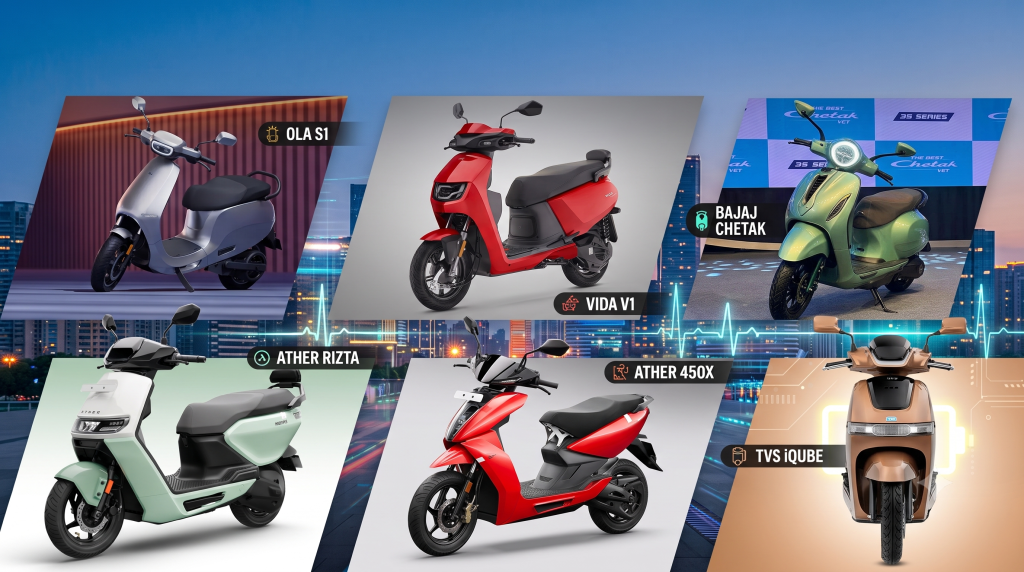
Top Electric Scooters Under ₹1.5 Lakh in India
A complete, SEO-optimized comparison covering real-world range, battery health, service networks, and total cost of ownership.
The Indian electric two-wheeler market has matured significantly. Buyers are no longer evaluating EVs as mere novelty items—they are looking for real-world reliability, total cost of ownership (TCO), build quality, and true range accuracy.
If you have a budget of under ₹1.5 Lakh (on-road/ex-showroom depending on state subsidies and variants), here is an in-depth breakdown of the absolute best electric scooters available in India today.
1. TVS iQube Series: The Quintessential Family Commuter
Best ComfortThe TVS iQube (specifically the 3.4 kWh / 3.5 kWh variants) remains one of India’s top-selling electric scooters. It bridges the gap between traditional petrol scooters like the Jupiter and modern EV technology.
Key Highlights
- Smooth Power Delivery: Powered by a hub-mounted motor producing up to 140 Nm of wheel torque, providing predictable and linear acceleration suitable for city traffic.
- Feature Package: Comes equipped with a 7-inch TFT screen, turn-by-turn navigation, Alexa voice assistance, Tire Pressure Monitoring System (TPMS), reverse mode, and Over-The-Air (OTA) updates.
- Service Network: Backed by TVS’s expansive nationwide dealership and service footprint, making spare parts and maintenance accessible across Tier-1, Tier-2, and Tier-3 cities.
2. Ather 450X & Ather Rizta: Performance Meets Practicality
Best Tech & Range AccuracyAther Energy continues to set industry benchmarks for software integration, build quality, and real-world range accuracy. Buyers in this price bracket generally consider two distinct models from Ather:
| Feature | Ather 450X (2.9/3.7 kWh) | Ather Rizta (Z/S) |
|---|---|---|
| Primary Focus | Performance & Handling | Family & Practicality |
| Motor Type | PMSM (Mid-Drive) | PMSM (Mid-Drive) |
| Peak Torque | 22 Nm | 22 Nm |
| Real-World Range (Zip) | ~90 – 105 km | ~100 – 110 km |
| Boot Space | 22 Liters | 34 Liters (Plus Frunk) |
Key Highlights
- Unmatched Range Predictability: Ather’s algorithm provides the most accurate distance-to-empty (DTE) readout in the industry. If the display shows 35 km, it delivers 35 km.
- Ather Grid Network: Access to Ather's dedicated fast-charging network across major urban centers.
- Rizta Family Scooter: Designed specifically with a wide seat, large footboard, and massive under-seat storage to compete directly with classic family commuters.
- 450X Performance: Agile chassis setup, sharp throttle response, Magic Twist regenerative braking, and hill-hold assist.
3. Bajaj Chetak (Chetak 3502 / Premium Series): Solid Metal Build
Best DurabilityCarrying forward the iconic Chetak heritage, Bajaj's EV offering stands out primarily due to its all-metal body construction and rugged durability.
Key Highlights
- Durable Sheet Metal Body: Offers superior structural integrity against panel cracks or impact damages compared to plastic/ABS panels used by competitors.
- Practical Ergonomics: Features a deep 35-liter boot, hill-hold assist, IP67-rated water ingress protection, keyless ignition, and reverse mode.
- Stable Daily Commuter: Tightly tuned suspension and robust build quality geared toward longevity over outright speed.
4. Hero Vida VX2 Series: Removable Battery Convenience
Best for ApartmentsHero MotoCorp’s Vida VX2 lineup (VX2 Go / VX2 Plus) addresses the primary pain point for buyers living in high-rise apartments: charging infrastructure.
Key Highlights
- Dual Removable Batteries: Unplugs easily to charge indoors using any standard 5A wall socket, eliminating the need for a dedicated outdoor garage plug.
- Battery-as-a-Service (BaaS) Option: Available via subscription models that reduce upfront acquisition costs significantly.
- Backed by Hero MotoCorp: Extensive distribution footprint across India with lower long-term service friction.
5. Ola S1 Series (S1X / S1 Air / S1 Pro): High Specs, High Consideration
Top Performance SpecsOla Electric vehicles lead on paper specs, offering class-topping power outputs, battery sizes, and claimed ranges.
Key Highlights
- Class-Leading Performance: High acceleration figures and top speeds across the 4 kWh variants.
- Loaded Feature Suite: Includes cruise control, proximity unlock, customizable dash themes, and multi-mode regeneration via MoveOS.
- Buyer Note: While specifications are high, buyer sentiment suggests inspecting local service center throughput and turnaround times prior to making a final purchase.
Comparing the Top 5 EV Scooters Under ₹1.5 Lakh
| Model | Battery Size | Peak Power | Claimed Range (IDC) | Top Speed | Primary Strengths |
|---|---|---|---|---|---|
| TVS iQube | 3.4 / 3.5 kWh | 5.9 bhp | 145 km | 78–82 km/h | Comfort, trusted service network, feature list |
| Ather 450X | 2.9 / 3.7 kWh | 8.5 bhp | 111–150 km | 90 km/h | Performance, handling, range accuracy |
| Ather Rizta | 2.9 / 3.7 kWh | 5.7 bhp | 123–159 km | 80 km/h | Massive seat, 34L boot, family ergonomics |
| Bajaj Chetak | 3.2 / 3.5 kWh | 4.2 bhp | 127–153 km | 73–80 km/h | Full-metal body, proven chassis durability |
| Hero Vida VX2 | 2.2 / 3.4 kWh | ~6.0 bhp | 94–110 km | 80 km/h | Dual removable batteries, BaaS options |
Essential Checklist Before Buying an EV Scooter
To make an informed purchase decision, evaluate these four critical factors:
Ignore Maximum Eco Range Figures
Always judge an EV by its City/Standard Mode range. Eco modes restrict acceleration and cap speeds (often to 40–50 km/h), making them impractical for standard arterial road traffic.
Evaluate Service Center Health
Visit your city's local service center before booking. A strong product can be hampered by poor after-sales support, while established brands with spare parts availability ensure smoother long-term ownership.
Verify Battery Health Policies & Warranties
The battery accounts for 40% to 50% of the scooter’s total cost. Look for brands offering 5-year or 8-year extended warranties that cover replacement if battery health drops below 70% state-of-health (SoH).
Calculate Total Cost of Ownership (TCO)
Electric scooters cost roughly ₹0.20 to ₹0.30 per km to run, compared to ₹2.00 to ₹2.50 per km for a standard 110cc petrol scooter. For an average daily commute of 30 km, the price premium of an EV is typically recovered within 18 to 24 months.