
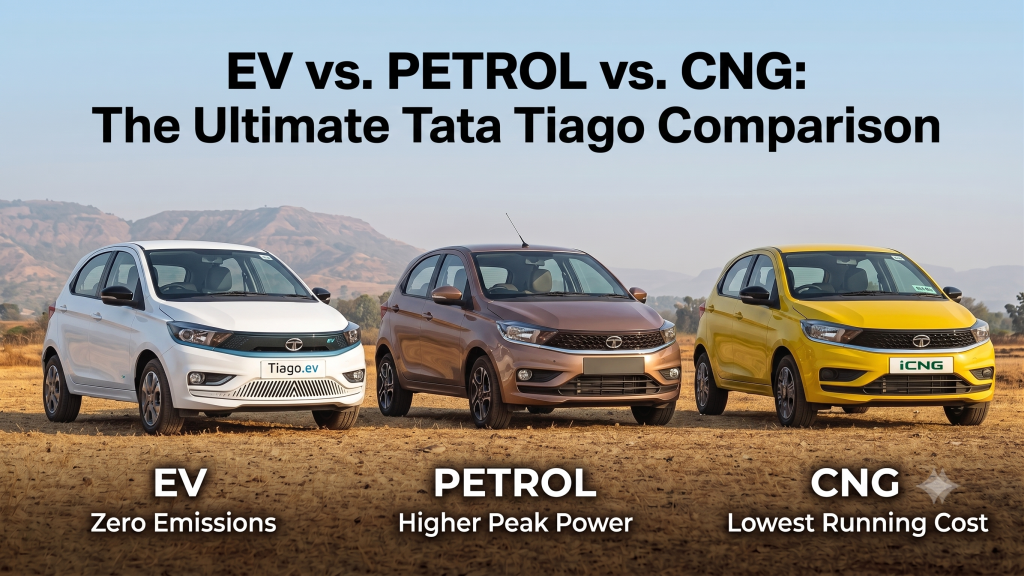
Petrol, CNG, or EV? Which Tata Tiago Makes the Most Sense?
When shopping for an affordable hatchback, deciding on the right powertrain can be overwhelming. While most automakers are still figuring out what the future holds, Tata Motors answered with a clear strategy for the Tiago lineup: "Why not all three?"
With identical dimensions, platform design, updated styling, and enhanced safety features like six airbags standard across all variants, the Tata Tiago offers Petrol, CNG (iCNG), and EV options. On the surface, they look almost identical—featuring sharper front bumpers, fresh lighting setups, new digital driver displays, and modernized interior ergonomics.
However, live with them, and you will quickly realize that each variant is engineered to solve three completely different driving and ownership needs. Here is a comprehensive breakdown to help you determine which Tata Tiago best fits your budget, commute, and lifestyle.
1. Tata Tiago Petrol: The Nicest to Drive
The petrol-powered Tiago is the simplest, lightest, and most straightforward car in the lineup. It requires zero lifestyle adjustments, no charging strategies, and no waiting in line at gas stations.
TATA TIAGO PETROL
- Engine: 1.2L 3-Cylinder Revotron Petrol
- Output: 85 BHP | 113 Nm Torque
- Transmission Options: 5-Speed Manual / 5-Speed AMT
- Best For: Driving enthusiasts, low-mileage drivers, open highways
Driving Experience & NVH
Mechanically, the 1.2L 3-cylinder engine produces 85 BHP and 113 Nm of torque. Refinement and Noise, Vibration, and Harshness (NVH) levels are noticeably improved over previous iterations. The steering loads up predictably, and the suspension setup remains a benchmark for comfort in this segment.
Who Should Buy the Petrol Tiago?
- Low Annual Mileage: If your daily drive is under 20–30 km, the higher purchase price of an EV or CNG model will take years to recover.
- Purists & Enthusiasts: The manual transmission paired with the full 85 BHP output offers the most natural, engaging feedback on open roads.
- Hassle-Free Ownership: No route planning or charging setups needed—just fill up the 35-liter tank and drive anywhere.
2. Tata Tiago iCNG: The Smartest & Most Practical
CNG vehicles traditionally demand major compromises: sacrificed boot space, lack of automatic options, and sluggish performance. The Tiago iCNG eliminates almost all of those compromises.
TATA TIAGO iCNG
- Powertrain: 1.2L Petrol + Twin-Cylinder CNG Tech
- Boot Space: ~107 Liters (vs. 242L Petrol)
- Running Cost: Approx. ₹4.14 / km
- Unique Feature: Direct Start in CNG mode + AMT Option
- Best For: Moderate-to-high city running without range anxiety
Key Innovations
- Twin-Cylinder Tech: By placing two smaller cylinders beneath the luggage floor rather than one massive tank in the center, the iCNG retains ~107 liters of usable boot space for soft bags and everyday luggage.
- CNG AMT Option: You can pair the CNG motor with an Automated Manual Transmission (AMT), preventing daily traffic fatigue.
- Direct CNG Start: Unlike older CNG systems that require starting on petrol before switching fuels, the Tiago iCNG can start directly on CNG.
Efficiency & Economics
In real-world testing, the Tiago iCNG delivers roughly 18.8 km/kg in the city and 20 km/kg on the highway. With an 8 kg usable CNG capacity, expect a pure CNG range of around 145 km. Paired with the standard 35-liter petrol tank, the combined driving range easily exceeds 600 km. At an estimated running cost of ₹4.14 per km, it offers substantial fuel savings over petrol.
3. Tata Tiago EV: The Easiest & Smoothness Champion
Electric vehicles used to come with an endless checklist of conditions and range anxiety. The updated Tiago EV changes that narrative—it no longer feels like an alternative fuel experiment, but rather the default city car choice.
TATA TIAGO EV
- Battery Capacities: 19.4 kWh (Medium) | 24 kWh (Long Range)
- Real-World Range: ~180 km – 205 km (Tested)
- Running Cost: Approx. ₹1.00 – ₹1.50 / km (Home Charging)
- Charging Time: 10% to 80% in ~58 mins (25 kW DC Fast Charger)
- Best For: Daily urban commuters with home-charging access
Driving Dynamics
With no gears to shift, power delivery from the electric motor is instant, linear, and completely silent. The placement of the battery pack under the floor lowers the car's center of gravity, giving it a stable, planted feel around corners and over highway undulations.
Real-World Tested Range
While official claimed figures hover higher, rigorous real-world testing (with AC set at 24°C, two passengers, and mixed traffic conditions) yields:
- City Loop Range: ~175 km to 185 km
- Highway Cruising Range: ~205 km
- Average Reliable Range: ~180 km on a full charge
Charging Economics
When charged at home using standard residential tariffs, the running cost drops to a low ₹1.00 – ₹1.50 per kilometer. Utilizing public DC fast chargers elevates this to roughly ₹2.93 per kilometer, which remains significantly cheaper than traditional fossil fuels.
Detailed Comparison: Petrol vs. CNG vs. EV
| Feature / Metric | Tiago Petrol | Tiago iCNG (AMT) | Tiago EV (24 kWh) |
|---|---|---|---|
| Primary Use Case | Highway & Mixed Commutes | Heavy Daily City Commute | Urban Daily Commute |
| Boot Space | 242 Liters (Full) | 107 Liters (Usable) | 240 Liters (Near Full) |
| Real-World Range | ~500–550 km (Tank) | ~145 km (CNG) + 400 km (Petrol) | ~180 km (Full Charge) |
| Running Cost / km | ~₹6.50 – ₹7.50 / km | ~₹4.14 / km | ~₹1.00 – ₹1.50 / km (Home) |
| Refinement & NVH | Moderate Engine Sound | Slight Lag in AMT | Silent, Zero Vibration |
| Refueling / Charge Time | 2–3 Minutes | 5–15 Minutes | 58 Mins (Fast) / 9 Hours (Home) |
Financial Analysis: EV vs. CNG Cost Recovery
When evaluating the Tiago iCNG AMT against the Tiago EV, price differentials play a crucial role in deciding which option offers the best value:
- Initial Price Gap: On average, the Tiago EV costs roughly ₹2.5 Lakhs more on-road than an equivalent iCNG AMT model.
- Per-Kilometer Savings: The EV saves approximately ₹2.64 per kilometer in fuel costs compared to the CNG variant when charged primarily at home.
- Break-Even Distance: To recover the higher initial purchase cost of the EV purely through fuel savings, you will need to drive roughly 95,000 kilometers.
- Time to Pay Off: At an average daily running of 40 km (~15,000 km per year), it takes approximately 6.3 years to reach the break-even point.
Decision Guide: Which Tiago Is Right for You?
Low Daily Mileage (< 30 km/day)
You prioritize a traditional driving feel, long highway trips, and the lowest initial price tag.
Heavy City Running (No Charging)
You need maximum fuel economy, drive frequently, but lack dedicated home charging facilities.
High Daily Running (Home Charging)
You want absolute smoothness, zero vibrations, and log 40-80+ km daily with home overnight charging.
Verdict: Which Tata Tiago Should You Buy?
- Buy the Tiago Petrol if: You drive under 20–30 km per day, value an engaging manual driving feel, frequently travel on long highway trips without planned stops, and want the lowest upfront purchase price.
- Buy the Tiago iCNG if: You have high monthly mileage, want low running costs, lack dedicated parking with a home charging setup, or frequently need to make unplanned long-distance trips without range anxiety.
- Buy the Tiago EV if: You log high daily city mileage (40–80+ km), have a dedicated home charging point, and prioritize a smooth, whisper-quiet drive free of gearbox lag.