
The Complete Tata Tigor Buyer’s Guide: Petrol, iCNG, EV & 2026 Updates Compared
Finding the right budget-friendly family car in India often boils down to balancing a few non-negotiables: uncompromised safety, realistic running costs, ride comfort, and long-term reliability.
While hatchback and pseudo-SUV styling trends dominate the sub-4-meter segment, sedans remain unmatched for high-speed stability, rear-seat comfort, and deep boot space. Standing tall as one of India's safest and most versatile options in this space is the Tata Tigor.
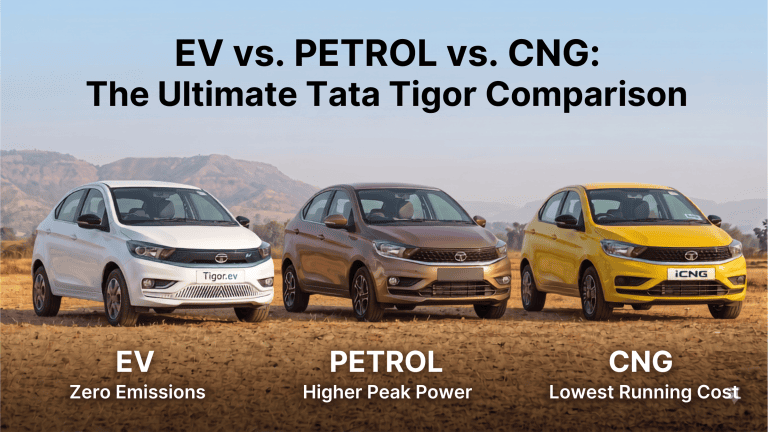
Whether you are looking at the value-for-money Petrol, the high-efficiency iCNG, the smooth Tigor EV, or the newly updated 2025 facelift model, this ultimate review and comparison breaks down performance, real-world mileage, ride dynamics, and ownership costs to help you make the right choice.
1. Tata Tigor Overview & Key Specifications
Built on a 4-Star Global NCAP safety-rated platform, the Tata Tigor features high-strength steel construction, dual airbags, ABS with EBD, Corner Stability Control, and Electronic Stability Program (ESP) across its lineup.
| Specification | Petrol (Revotron 1.2L) | iCNG (Twin-Cylinder) | Tigor EV (Ziptron) |
|---|---|---|---|
| Engine / Powertrain | 1.2L 3-Cylinder Petrol | 1.2L Petrol + CNG | 26 kWh Li-ion Battery |
| Power Output | 86 PS @ 6000 RPM | 73.5 PS (CNG) / 86 PS (Petrol) | 75 HP (55 kW) |
| Torque | 113 Nm @ 3300 RPM | 95 Nm (CNG) / 113 Nm (Petrol) | 170 Nm |
| Transmission Options | 5-Speed MT / 5-Speed AMT | 5-Speed MT / 5-Speed AMT | Single-Speed Automatic |
| Claimed Mileage / Range | ~19.2 km/l | 26.4–28.0 km/kg | 315 km ARAI (180–210 km real) |
| Boot Space | 419 Liters | ~200 Liters (Usable twin-cyl) | 316 Liters |
| Ground Clearance | 170 mm | 165–170 mm | 172 mm |
2. Real-World Mileage & Fuel Efficiency
Running costs are a top priority when upgrading from a two-wheeler or replacing an older hatchback. Here is how all three powertrain options perform in actual city traffic and highway cruising:
| Powertrain | City Driving | Highway Cruising |
|---|---|---|
| 1.2L Petrol | 13 - 15 km/l | 17 - 20 km/l |
| iCNG (Gas) | 18 - 22 km/kg | 26 - 30+ km/kg |
| Tigor EV | 180 - 200 km / charge | 150 - 180 km / charge |
- Cost-Per-Kilometer Analysis: Real-world testing reveals that the iCNG variant runs at approximately ₹3.90 to ₹4.20 per kilometer, compared to nearly ₹8.50+ per kilometer for a standard petrol sedan.
- The EV Advantage: If you charge primarily at home overnight, the Tigor EV lowers your commuting costs even further to roughly ₹1.00 to ₹1.50 per kilometer.
3. Comparing Powertrains: Petrol vs. iCNG vs. EV
Every drivetrain of the Tata Tigor addresses a distinct driving style and budget.
Low Initial Cost
Best suited for light city commutes and maximum upfront savings.
Maximum Savings
Ideal for heavy traffic, long commutes, and maximum fuel cost efficiency.
Zero Emissions
Delivers instant torque, ultra-low running costs, and a quiet cabin experience.
A. 1.2L Revotron Petrol (Manual & AMT)
- Driving Feel: The 3-cylinder Revotron engine delivers smooth, linear power for daily commuting. First-gear pickup is effortless, making it very forgiving in stop-and-go city traffic.
- Refinement: While mild 3-cylinder thrum is present at idle, NVH (Noise, Vibration, Harshness) levels smooth out on the move.
- Best For: Buyers on a strict budget who drive under 800 km per month.
B. Tigor iCNG (Twin-Cylinder Tech & Segment-First AMT)
- No Feature Compromise: Unlike competitors who restrict CNG to bare-bones base trims, Tata offers the iCNG even in the top-tier XZ+ and XZ+ Lux variants.
- Twin-Cylinder Packing: Older CNG models mounted a single bulky tank, reducing boot space from 419L down to a tight 205L. Newer twin-cylinder models tuck two smaller tanks beneath the rear floor, opening up practical boot space for duffel bags and carry-on suitcases.
- Performance & Direct Start: With an integrated single ECU, the transition between petrol and CNG is virtually unnoticeable. The car can start directly in CNG mode, saving fuel on every start.
- AMT Convenience: The Tigor iCNG AMT eliminates gear-shifting fatigue in heavy traffic while maintaining exceptional fuel efficiency.
C. Tigor EV (Ziptron Architecture)
- Instant Torque & Smoothness: Delivering 170 Nm of instant torque, the Tigor EV accelerates briskly in Sport mode (0–100 km/h in under 15 seconds).
- Refinement: Cabins remain completely silent with zero tailpipe emissions and low operating noise.
- Charging: Fast DC charging powers the 26 kWh battery pack from 0% to 80% in about 60 minutes, while a standard 15A home socket takes around 8.5 hours.
4. What's New in the 2026 Tata Tigor Facelift?
The updated 2025 Tata Tigor brings several premium features down from higher-segment SUVs like the Nexon and Harrier:
- Illuminated 2-Spoke Steering Wheel: Borrowed directly from newer Tata models, featuring an illuminated central Tata logo and mounted audio/cruise controls.
- 10.25-Inch Harman Touchscreen: Upgraded infotainment display with higher resolution, wireless Apple CarPlay, and Android Auto.
- 360-Degree HD Camera: Blind-spot monitors and multi-angle 3D camera feeds activate automatically when signaling or selecting reverse.
- Subtle Exterior Refinements: A redesigned front grille with chrome embellishments, updated LED headlamp detailing, new 15-inch alloy/stylized wheel covers, and a clear-lens 3D LED taillamp cluster.
- Rain-Sensing Wipers & Cooled Glovebox: Added convenience features for changing weather conditions and long drives.
5. Performance, Ride Quality & Handling Comparison
How do these models handle track tests, rough patches, and city streets?
- Suspension & Ground Clearance: Standard petrol and iCNG models feature 170 mm ground clearance, easily navigating large speed breakers and unpaved roads without scraping the underbody. The heavy-duty suspension tuning absorbs potholes with minimal cabin movement.
- Handling Extra Weight: The EV carries an extra ~200 kg due to its battery pack. To manage this, its suspension is slightly stiffer. On rough roads, the lighter iCNG and Petrol variants ride slightly flatter and absorb sharp bumps more comfortably.
- Cornering & Braking: In handling limit tests (60–70 km/h cornering runs), the lighter iCNG chassis stays composed with predictable understeer. Standard low-rolling-resistance tires on the EV mean it reaches its grip limit slightly earlier in sharp evasive maneuvers.
6. Long-Term Reliability & Maintenance (80,000+ km Owner Review)
Real-world feedback from long-term owners reveals how the Tigor holds up after years of daily driving:
80,000+ KM Owner Maintenance Summary
- Engine & Clutch Longevity: The 1.2L Revotron engine and manual gearbox routinely cross 80,000+ km with zero major mechanical issues when serviced every 10,000 km.
- Suspension & Bushings: Wear-and-tear items like suspension arm bushes and engine mountings may require attention around 60,000 to 70,000 km. Utilizing genuine Tata spare parts keeps overall repair costs low.
- Body Shell Integrity: Regular washing and basic anti-rust maintenance (such as spraying exposed metal joints during monsoon seasons) prevent chassis corrosion over long ownership periods.
7. Variant Selection & Buying Guide
Choosing the right variant depends on your budget and desired features:
Digital Cluster, Power Windows, Audio System
10.25" Screen, 360 Camera, Auto AC
Automatic Convenience + Low Fuel Cost
Base to Mid Variants (XE / XM / XT)
- Price Range: Starting from ₹5.99 Lakhs ex-showroom.
- Features Included: Digital instrument cluster, all four power windows, manual AC, standard safety kit, and a 419L boot.
- Verdict: Ideal for first-time buyers looking for a safe sub-4-meter family sedan under ₹7 Lakhs on-road.
Top-Spec Variants (XZ+ / XZ+ Lux)
- Price Range: ₹7.50 Lakhs to ₹9.75 Lakhs ex-showroom.
- Features Included: 10.25-inch touchscreen display, 8-speaker Harman audio system, 360-degree camera system, leatherette-wrapped steering wheel, push-button start, automatic climate control, and cooled glovebox.
- Verdict: Recommended if you want luxury features alongside a 4-Star NCAP safety rating.
8. Final Verdict: Which Tata Tigor Should You Buy?
The Tata Tigor remains one of the most practical, value-packed, and structurally safe compact sedans on Indian roads.
Buy Petrol If...
You are on a strict budget, drive under 800 km a month, and want maximum boot space (419L) at an entry-level price.
Buy iCNG If...
You drive over 1,000 km per month, want low running costs (~₹4/km) without sacrificing automatic transmission comfort or top-spec features.
Buy EV If...
You want a quiet, zero-emission city commuter with low home-charging costs and swift low-speed acceleration.