
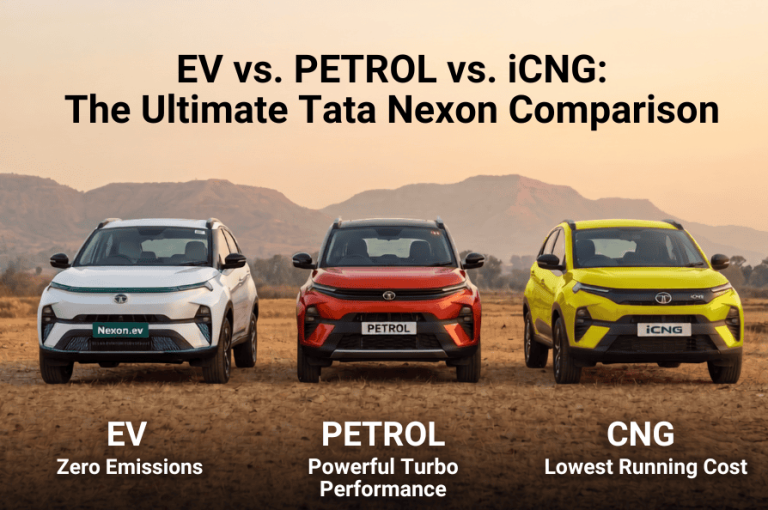
Tata Nexon Powertrain Mega-Guide: Petrol, Diesel, iCNG, or EV — Which One Should You Buy?
Choosing a compact SUV used to be simple. You picked between a petrol or a diesel engine, picked a color, and drove off the lot. Tata Motors has turned the compact SUV segment on its head with the Tata Nexon. Today, the Nexon holds the title of being the only car in India offered across four distinct fuel options: Turbo-Petrol, Diesel, iCNG, and All-Electric (EV). Combined with its wide array of "Persona" trim levels, there are over 100 individual Nexon configurations available.
While having endless choices is great for buyers, it also brings decision paralysis. Should you pay the premium upfront for an EV? Is the revolutionary twin-cylinder iCNG really as practical as Tata claims? Does diesel still make sense in a world of stricter emissions? In this ultimate Nexon powertrain guide, we break down real-world performance, feature differences, practicality compromises, and conduct a detailed 5-Year Total Cost of Ownership (TCO) analysis to help you pick the exact Nexon for your driveway.
1. Tata Nexon iCNG: A Segment-Shaking Practicality Play
Historically, Compressed Natural Gas (CNG) cars were viewed as bare-bones, low-power transport options where buyers accepted two major compromises: a gutless naturally aspirated engine and zero boot space. The Nexon iCNG destroys those stereotypes by introducing several segment-first innovations:
- First Turbo-Petrol CNG Engine: Pairs a 1.2L turbocharged engine with a CNG kit.
- First 6-Speed Manual CNG: Better highway cruising without straining the engine.
- First Panoramic Sunroof in a CNG Car: Available on top-spec variants like the Fearless Plus.
- Twin-Cylinder Technology: Dual 30-liter tanks (60L total water capacity / ~9kg gas capacity) tucked neatly beneath the boot floor.
Practicality & Boot Space
By moving the dual tanks under the load floor and mounting the spare wheel under the car's rear body, the Nexon iCNG retains 321 liters of usable boot space (down just 61 liters from the standard 382 liters). You can comfortably carry three or four cabin suitcases without folding the seats.
Real-World Driving Dynamics & Highway Range
On paper, the iCNG version loses 20 horsepower compared to its petrol counterpart, producing 100 hp, but keeps an identical 170 Nm of peak torque. Crucially, that peak torque is delivered over a narrower rev range (1,000 RPM band vs 2,500 RPM band in petrol).
In real-world testing:
- Highway Range: On a sedate highway run, the Nexon iCNG delivered 204 km on a single tank before automatically switching over to petrol mode. Re-filling required roughly 7.5 kg of CNG (actual fill amounts vary based on pump pressure and ambient temperature).
- 0–100 km/h Acceleration: In CNG mode, the car hits 100 km/h in approximately 14.3 seconds. In Petrol mode (acting effectively as a 'Sport' toggle), it drops to roughly 12.8 seconds.
- Suspension Tuning: To manage the ~120 kg weight increase from the tanks, Tata retuned the rear suspension slightly softer. The result is an even plush behavior over potholes and harsh roads, though it introduces a slight vertical bobbing over high-speed highway crests.
2. Tata Nexon EV: The Tech-Loaded Efficiency Champ
The Nexon EV (offered in Medium Range and Long Range / 45 kWh variants) represents the top tier of Tata’s technological capability. Featuring Tata’s Generation 1.5 EV architecture, it drops a lighter, higher-revving (16,000 RPM) permanent magnet synchronous motor under the hood.
- 12.3-inch Ultra-Wide Touchscreen with Arcade.ev App Store
- Steering Paddle Shifters for Multi-Mode Regenerative Braking
- Vehicle-to-Load (V2L) & Vehicle-to-Vehicle (V2V) Charging Capabilities
- Full-Width Connected Front DRL with Charge Level Progress Indicator
Real-World Range & Charging Realities
- Claimed vs. Real Range: While ARAI claims up to 465 km for the 40.5 kWh / 45 kWh versions, long-term owners report real-world city/highway yields between 350 km and 380 km on a disciplined foot (tracking ~120 to 130 Wh/km efficiency). Real-world highway runs at 80–90 km/h with cruise control yield a dependable 350 km.
- AC Charging Times: A home 3.3 kW socket takes roughly 15 to 18 hours (10% to 90%), making an overnight top-up effortless. Installing a 7.2 kW AC wallbox drops that to approximately 8 hours.
- DC Fast Charging: Capped at around 30 kW peak, taking roughly 56 minutes for a 10%–80% charge.
The EV Interior Compromise: Under-Thigh Support
Because the heavy battery pack is mounted under the vehicle’s floorboard, two interior characteristics change compared to ICE (Internal Combustion Engine) Nexons:
- Ground Clearance: Drops from 208 mm on the standard car to roughly 170–190 mm (laden) on the EV. You need to take sharp speed bumps with slightly more care.
- Rear Seating Ergonomics: The cabin floor sits roughly 2 inches higher. Rear passengers sit in a slightly "knees-up" position, which noticeably reduces under-thigh support compared to the petrol or diesel variants.
3. Side-by-Side Comparison: Spec Sheet & Features
| Feature / Spec | Nexon Turbo-Petrol | Nexon Diesel | Nexon iCNG | Nexon EV (Long Range) |
|---|---|---|---|---|
| Engine / Powertrain | 1.2L Turbo-Petrol | 1.5L Turbo-Diesel | 1.2L Turbo-iCNG | Gen 1.5 Permanent Magnet Motor |
| Power Output | 120 hp | 115 hp | 100 hp | 145 hp |
| Torque Output | 170 Nm | 260 Nm | 170 Nm | 215 Nm |
| Transmission Options | 5-MT, 6-MT, 6-AMT, 7-DCA | 6-MT, 6-AMT | 6-Speed Manual | Single-Speed Automatic |
| Claimed Mileage / Range | 17.4 km/l | 23.2 km/l | 24 km/kg | 465 km (ARAI) |
| Real-World Mileage | 11–13 km/l | 15–17 km/l | 16–18 km/kg | 350–380 km (Actual) |
| Boot Space | 382 Liters | 382 Liters | 321 Liters | 350 Liters |
| Rear Floor Profile | Standard (Plush thigh support) | Standard (Plush thigh support) | Standard (Plush thigh support) | Raised ~2 inches (Knees-up) |
| Rear Brakes | Drum | Drum | Drum | Disc Brakes Standard |
4. 5-Year Total Cost of Ownership (TCO) Breakdown
Is buying an EV actually cheaper, or does the higher initial purchase price wipe out your fuel savings? Let's analyze a complete 5-year ownership model comparing base/mid variants, incorporating Initial Purchase Cost, Fuel/Electricity Inflation, Regular Maintenance, Insurance, and 5-Year Resale Depreciation.
- Petrol Price (Projected 5-Yr Avg): ₹110 / Liter
- Diesel Price (Projected 5-Yr Avg): ₹100 / Liter
- CNG Price (Projected 5-Yr Avg): ₹100 / kg
- EV Charging Rate (Projected 5-Yr Avg): ₹12 / kWh (Unit)
- 5-Year Depreciation Reserve: Petrol retains ~50% on-road value; EV retains ~40% on-road value due to battery aging market perceptions.
Scenario A: Low Usage (500 km / Month — 30,000 km over 5 Years)
Ideal for short daily office runs and occasional weekend errands.
| Expense Head | Petrol (Smart+) | Diesel | iCNG | EV (Base) |
|---|---|---|---|---|
| On-Road Price (Approx) | ₹10,24,000 | ₹11,95,000 | ₹10,98,000 | ₹13,24,000 |
| Fuel/Energy Cost (@ 30k km) | ₹3,00,000 | ₹1,87,500 | ₹1,76,400 | ₹39,000 |
| 5-Year Maintenance/Service | ₹40,000 | ₹45,000 | ₹45,000 | ₹30,000 |
| Total Out-of-Pocket Expense | ₹13,64,000 | ₹14,27,500 | ₹13,19,400 | ₹13,93,000 |
Scenario B: Moderate Usage (1,000 km / Month — 60,000 km over 5 Years)
The average Indian family usage pattern.
| Expense Head | Petrol | Diesel | iCNG | EV |
|---|---|---|---|---|
| Total Out-of-Pocket TCO | ₹16,64,000 | ₹16,50,000 | ₹14,95,800 | ₹14,32,200 |
Scenario C: High Usage (2,000 km / Month — 1,20,000 km over 5 Years)
Ideal for business owners, heavy commuters, and cross-city travelers.
| Expense Head | Petrol | Diesel | iCNG | EV |
|---|---|---|---|---|
| On-Road Price | ₹10,24,000 | ₹11,95,000 | ₹10,98,000 | ₹13,24,000 |
| Fuel/Energy Cost (@ 120k km) | ₹12,00,000 | ₹7,50,000 | ₹7,05,600 | ₹1,56,000 |
| 5-Year Maintenance/Service | ₹40,000 | ₹45,000 | ₹45,000 | ₹30,000 |
| Total Out-of-Pocket Expense | ₹22,64,000 | ₹19,90,000 | ₹18,48,600 | ₹15,10,000 |
5. Pros & Cons Summary
Tata Nexon iCNG
- Massive running cost savings without sacrificing boot space (321L usable capacity).
- Segment-first features: Panoramic sunroof, Turbo engine, and 6-speed manual gearbox.
- Direct CNG start capability with smooth ECU transition.
- Long queues at public CNG filling stations.
- Notchy, rubbery manual gear shifts; no automatic gearbox option yet.
- Weight penalty adds slight vertical movement over highway dips.
Tata Nexon EV
- Ultra-low running cost (~₹1.30 per km) with instant torque and silent operation.
- Top-tier technology: 12.3-inch screen, paddle-controlled regen levels, V2L/V2V capabilities.
- Magic-carpet ride quality with 4-wheel disc brakes standard.
- Higher initial acquisition cost.
- Compromised rear under-thigh support due to the raised battery floor.
- Public charging infrastructure can still pose highway planning friction.
Tata Nexon Petrol / Diesel
- Maximum rear seat comfort and uncompromised 208 mm ground clearance.
- Diesel offers 260 Nm of torque, making it an effortless highway cruiser.
- Zero range anxiety with widespread fuel infrastructure.
- Petrol variant is relatively thirsty in city traffic (11–12 km/l real world).
- Regulatory uncertainties surrounding 10-year diesel lifespans in major metro areas (e.g., Delhi-NCR).
6. Final Buying Recommendation: Which One Should You Buy?
- Buy the Nexon Petrol if your driving is strictly limited to under 600 km a month, you want to keep initial loan EMIs low, and you prioritize maximum rear-seat under-thigh comfort.
- Buy the Nexon iCNG if you want the daily savings of an EV without range anxiety or home-charging logistics, and you refuse to compromise on premium features like a panoramic sunroof and usable boot space.
- Buy the Nexon EV if you drive over 1,000–1,500 km every month and primarily stick to urban routes or predictable intercity corridors. The whisper-quiet drive, zero tailpipe emissions, and massive long-term financial savings make it a stellar product.
- Buy the Nexon Diesel if you are a long-distance highway runner who craves effortless overtaking torque, high fuel economy at triple-digit speeds, and predictable multi-state range.