
What is e-Rupee (CBDC)? How India's Digital Rupee Works, Differences From UPI & Bitcoin, and How to Use It
Discover how the Reserve Bank of India’s official digital currency brings paper cash notes into your smartphone, offering zero bank-server failures, micro-transaction privacy, and seamless payments.
What is the RBI’s e-Rupee (Digital Rupee)?
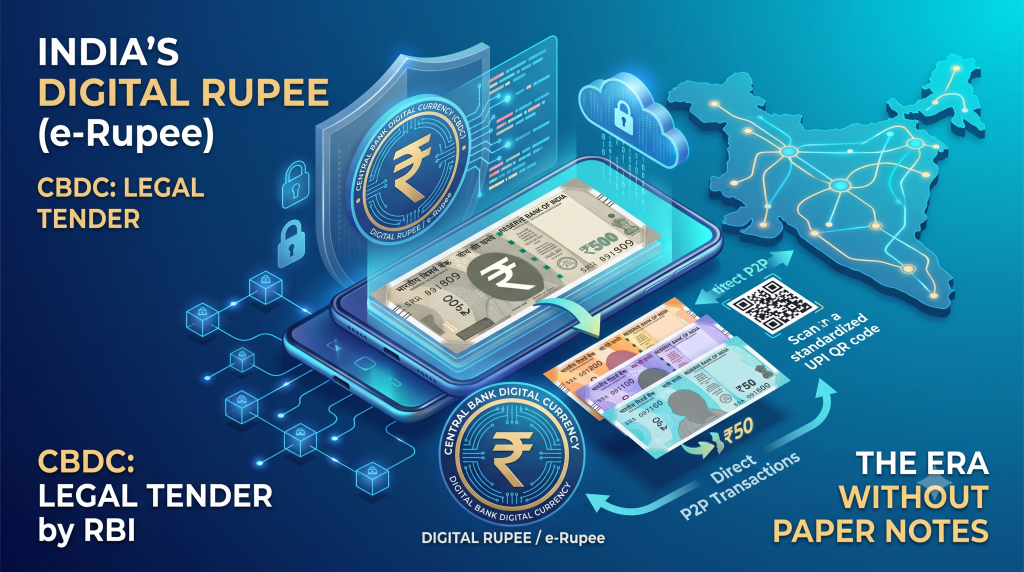
The e-Rupee is a Central Bank Digital Currency (CBDC). It is not a third-party app balance, nor is it a volatile cryptocurrency. It is the exact digital equivalent of India's physical paper currency and coins, issued directly by the Reserve Bank of India (RBI).
The Anatomy of a Digital Token
Unlike bank balances that show up as plain numbers on a screen, the e-Rupee operates as digital tokens.
- Familiar Denominations: Issued in the exact same denominations as cash: coins (50 paise, ₹1, ₹2) and notes (₹5, ₹10, ₹20, ₹50, ₹100, ₹200, ₹500).
- Serial Numbers & Signatures: Every single digital note carries the official RBI logo, the Governor’s signature, and a unique cryptographic serial number.
- Digital Change: If you pay a ₹50 bill using a ₹500 digital note, the app automatically splits the token. ₹50 goes to the merchant, and ₹450 instantly returns to your wallet as standard smaller digital notes (e.g., two ₹200 notes and one ₹50 note).
| Feature | Physical Paper Currency | e-Rupee Digital Token |
|---|---|---|
| Format | Paper Note / Metallic Coin | Cryptographic Digital Token |
| Identifier | Physical Serial Number | Unique Cryptographic Serial Number |
| Storage | Physical Pocket Wallet | Bank e-Rupee App Wallet |
| Settlement | Direct Peer-to-Peer | Direct Peer-to-Peer |
e-Rupee vs. UPI vs. Bitcoin: Key Differences
It is easy to confuse the e-Rupee with existing digital payment methods or cryptocurrencies, but their underlying architectures are fundamentally different.
| Feature | UPI (Unified Payments) | e-Rupee (CBDC) | Bitcoin & Cryptos |
|---|---|---|---|
| Architecture | Account-based | Token-based | Decentralized Blockchain |
| Settlement Route | Customer Bank → NPCI → Merchant Bank | Direct Wallet-to-Wallet | Peer-to-Peer Network |
| Server Failure Risk | High (Fails if bank servers drop) | Zero Bank-Server Dependency | Dependent on Network Nodes |
| Bank Statement Impact | Cluttered with micro-transactions | 100% Private (Only loads/redemptions show) | Not connected to bank accounts |
| Value & Taxation | Equal to INR (No Tax) | 1:1 Sovereign Currency (No Tax) | Volatile (30% VDA Tax in India) |
1. Why e-Rupee Beats UPI Downtimes
When you scan a UPI QR code, your bank’s server must connect to the merchant’s bank server. If either server is down, you get the dreaded "Payment Processing..." spinner. Since e-Rupee is cash in digital form, money moves directly between mobile wallets—bypassing intermediary core banking servers entirely.
2. Sovereign Security vs. Crypto Volatility
Cryptocurrencies like Bitcoin are decentralized, highly volatile, and carry zero intrinsic value or government backing. The e-Rupee is centrally issued by the RBI, carries zero volatility risk, and incurs no asset transfer taxes.
Official Pilot Partners: Participating Banks & App Directory
Source: Indian Banks' Association (IBA)
The RBI's retail Digital Rupee pilot currently operates through 19 major banks along with approved non-bank partners. If you hold a KYC-compliant account with any of these banks, you can download their respective Digital Rupee app today:
| # | Pilot Bank | Official App Name |
|---|---|---|
| 1 | State Bank of India (SBI) | eRupee by SBI |
| 2 | ICICI Bank | Digital Rupee By ICICI Bank |
| 3 | IDFC FIRST Bank | IDFC FIRST Bank Digital Rupee |
| 4 | YES BANK | Yes PAY Next (via "My Digital Rupee Wallet") |
| 5 | HDFC Bank | HDFC Bank Digital Rupee |
| 6 | Union Bank of India | Digital Rupee By UBI |
| 7 | Bank of Baroda | Bob World Digital Rupee |
| 8 | Kotak Mahindra Bank | Digital Rupee by Kotak Bank |
| 9 | Canara Bank | Canara Digital Rupee |
| 10 | Axis Bank | Axis Mobile Digital Rupee |
| 11 | IndusInd Bank | Digital Rupee by IndusInd Bank |
| 12 | Punjab National Bank (PNB) | PNB Digital Rupee |
| 13 | Federal Bank | Federal Bank Digital Rupee |
| 14 | Karnataka Bank | Karnataka Bank Digital Rupee |
| 15 | Indian Bank | Indian Bank Digital Rupee |
| 16 | IDBI Bank | IDBI eRupee |
| 17 | UCO Bank | UCO Digital Rupee |
| 18 | Bank of Maharashtra | eRupee by Bank of Maharashtra |
| 19 | Bank of India | Bank of India Digital Rupee |
Live Experiments: Testing the e-Rupee in Real Life
Experiment 1: Serial Number Transfer
Test: Sending a ₹2 digital note (Serial ending in #691) between smartphones.
Result: Confirmed. The exact serial number (#691) moved instantly to the recipient's wallet, proving tokens behave like physical currency notes.
Experiment 2: Digital Change Generation
Test: Sending ₹4 when holding only a single ₹5 digital note token.
Result: The system routed the ₹5 token through the issuing vault, delivered ₹4 in digital coins to the recipient, and returned ₹1 in change back to the sender.
Experiment 3: Loading ₹888.50
Test: Loading custom non-standard currency amounts into the wallet.
Result: By loading ₹888.50, you receive exactly one token of every denomination: 50p, ₹1, ₹2, ₹5, ₹10, ₹20, ₹50, ₹100, ₹200, and ₹500.
4 Major Benefits of Using the Digital Rupee
- Banking Privacy for Micro-Transactions: Small ₹15 tea or ₹20 snack payments will no longer clutter your bank statement. Bank managers assessing loan applications will only see lump-sum wallet loads.
- Reduces Cash Printing Costs: The RBI spends ₹4,000 to ₹5,000 crore annually printing, transporting, and managing physical paper currency and ATMs.
- Financial Inclusion Without Bank Accounts: Future phases will allow individuals in remote regions to hold and transfer digital money securely via offline wallets without needing formal banking accounts.
- Eradication of Counterfeit Notes: Cryptographically encrypted on RBI’s ledger, e-Rupee tokens cannot be duplicated or forged.
Step-by-Step Guide: How to Set Up Your e-Rupee Wallet
Download the Official App
Search for your participating bank’s official Digital Rupee app on Google Play Store or Apple App Store (e.g., SBI eRupee).
SIM Verification & Biometrics
Select your bank-registered SIM card to complete SMS verification, then set up Biometric login and a 6-digit Wallet PIN.
Link Account via Debit Card
Verify your bank account by entering the last 6 digits and expiry date of your active bank debit card.
Load & Spend Funds
Swipe notes upwards to load tokens into your wallet. Scan any standard retail UPI QR code to make instant payments.
Frequently Asked Questions (FAQs)
1. Do I need an internet connection for e-Rupee?
Current pilot phases require an active internet connection. However, the RBI is actively developing and testing offline payments via SMS and Near-Field Communication (NFC).
2. Do I earn interest on e-Rupee stored in my wallet?
No. Just like physical cash in your physical wallet, e-Rupee tokens do not earn interest. You can redeem tokens back into your bank savings account anytime to earn interest.
3. Can I scan standard Google Pay or PhonePe QR codes?
Yes! The RBI has made e-Rupee wallets completely interoperable with standard merchant UPI QR codes across retail stores in India.