
First Period: Signs, Symptoms, and What to Expect
Getting your first period—medically known as menarche—is a major milestone during puberty. It signals that your reproductive system is maturing. While starting your period can feel overwhelming or confusing, it is a completely natural biological process shared by billions of people around the world.
1. What Is a Period and Why Does It Happen?
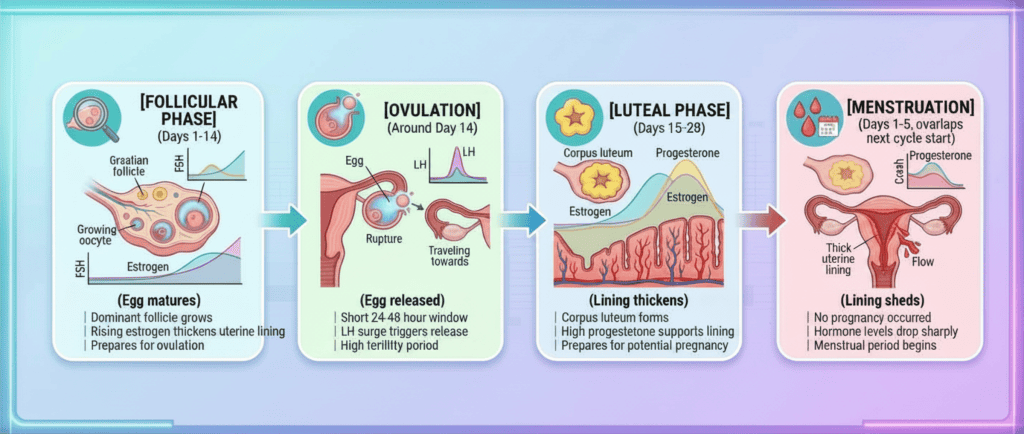
A period is part of the monthly menstrual cycle. Every month, the female body prepares for the possibility of pregnancy through a carefully timed release of hormones, primarily estrogen and progesterone.
Phase 1 Follicular Phase
(Egg matures)
(Egg matures)
→
Phase 2 Ovulation
(Egg released)
(Egg released)
→
Phase 3 Luteal Phase
(Lining thickens)
(Lining thickens)
→
Phase 4 Menstruation
(Lining sheds)
(Lining sheds)
- Ovulation: An ovary releases a mature egg from a tiny sac called a follicle into the fallopian tube.
- Lining Build-up: The uterus builds up a nutrient-rich tissue lining called the endometrium to prepare a supportive space in case the egg is fertilized.
- Shedding (Menstruation): If the egg remains unfertilized, the body no longer needs this thick endometrium. The lining breaks down and exits the body through the vagina as a mixture of tissue, fluid, and blood.

Limited offer
2. When Does First Period Usually Start?
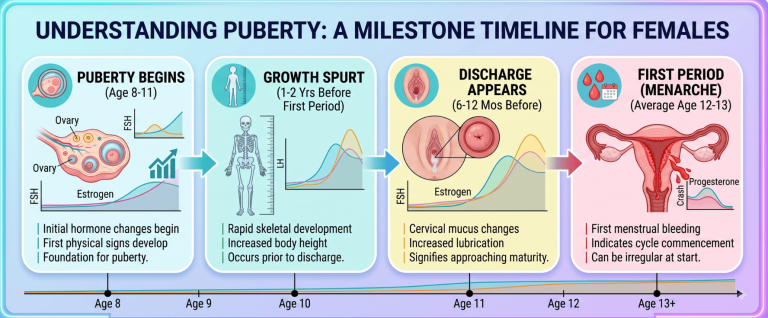
Most girls get their first period between the ages of 9 and 15 (with 12 to 13 being the average).
Puberty Begins
Age 8–11
Body starts initial developmental transitions.
Growth Spurt
1–2 Yrs Before
Rapid growth in height and overall stature.
Discharge Appears
6–12 Mos Before
Vaginal fluid self-cleaning begins.
First Period
Average Age 12–13
Menarche official onset occurs.
Key Signs Your First Period Is Coming Soon
Your body sends several signals in the 1 to 3 years leading up to menarche:
- Breast Development (Breast Buds): Your breasts usually begin to grow 2 to 3 years before your period starts.
- Pubic and Body Hair: Fine hair starts growing in the pubic region and underarms 1 to 2 years before menarche.
- Vaginal Discharge: A clear, white, or creamy fluid in your underwear often begins 6 to 12 months prior. This is your vagina’s natural self-cleaning process.
- Growth Spurts: Periods frequently begin about 6 to 12 months after reaching peak height growth during puberty.
- Skin Changes and Body Odor: Active hormones stimulate oil and sweat glands, leading to acne breakouts and new body odor.
Limited offer
3. The History & Biology of Menarche
From an evolutionary standpoint, the body evaluates energy stores before triggering puberty. Research shows a minimum threshold of body fat (roughly 17%) is necessary for menarche to begin.
| Historical Era | Average Age of First Period | Primary Factors |
|---|---|---|
| Prehistoric / Hunter-Gatherer | ~16 years old | High physical activity, lean diets, lower body fat percentages |
| Ancient Egypt & Greco-Roman | 13–15 years old | Improved agricultural access; medical texts like the Kahun Papyrus documented menstrual care |
| Modern Day | 12–13 years old | Consistent nutrition, higher overall body fat ratios, medical advancements |
4. What Does the First Period Look and Feel Like?
First periods vary significantly from person to person. It rarely looks like a dramatic, heavy flow right away.
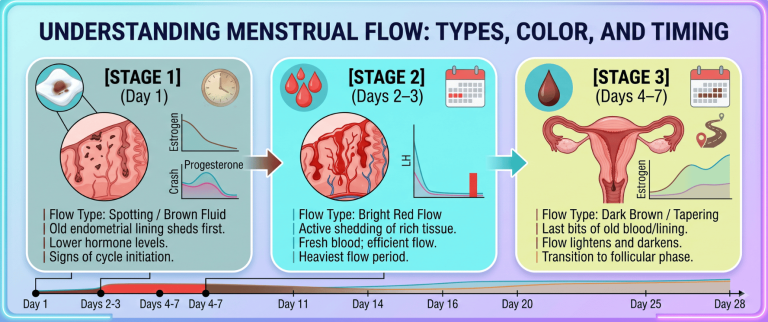
Day 1 Spotting / Brown Fluid
→
Days 2–3 Bright Red Flow
→
Days 4–7 Dark Brown / Tapering
- Color: The fluid can range from light pink or dark brown to bright red. Brown blood simply means the blood took longer to exit the uterus and oxidized along the way.
- Flow Volume: The first period might be light spotting (a few drops) or a light flow. The average total blood lost across an entire period is only about 2 to 3 tablespoons (30–45 mL).
- Duration: A period typically lasts between 3 and 7 days.
- Irregularity: It is completely normal for your cycle to be irregular for the first 1 to 2 years. You might get a period one month, skip three months, and then get it again as your hormone levels stabilize.

6. Guide to Period Products
There are multiple options available for managing menstrual flow. Choose what feels most comfortable for you.
| Product | How It Works | Reusable? | Best Used For |
|---|---|---|---|
| Sanitary Pads | Sticks inside underwear to absorb flow on the outside. | Disposable / Reusable options | Beginners, overnight protection, general daily use. |
| Period Underwear | Underwear built with integrated absorbent layers. | Reusable | Beginners, light-to-medium flow days, backup protection. |
| Tampons | Soft cotton cylinder inserted into the vagina to absorb flow internally. | Disposable | Swimming, sports, active lifestyles. |
| Menstrual Cups / Discs | Flexible silicone cups inserted into the vagina to collect flow internally. | Reusable | Eco-friendly preference, long-wear protection (up to 12 hrs). |
| Panty Liners | Ultra-thin mini-pads. | Disposable | Daily vaginal discharge, light spotting, period backup. |
7. How to Put On a Pad: Step-by-Step
1
Unwrap the Pad
Remove the pad from its wrapper. Save the plastic wrapper to wrap up and dispose of a used pad later.
2
Position the Adhesive Side
Peel off the paper backing to expose the sticky strip. Center the absorbent side facing up inside the crotch panel of your underwear.
3
Secure the Wings
If the pad has side flaps ("wings"), peel off their paper backings, fold them over the outside edges of your underwear, and press firmly to lock the pad in place.
4
Change Periodically
Replace your pad every 4 to 6 hours (or sooner if flow is heavy) to stay clean, fresh, and prevent leaks. Dispose of used pads in a trash bin—never flush period products down the toilet.
8. How to Build an Emergency First Period Kit
Being prepared prevents anxiety about getting your period unexpectedly while at school or away from home. Keep a small, discrete pouch in your backpack containing:
My Emergency Period Kit Checklist
✓ 2–3 Regular Sanitary Pads
✓ 1 Pair of Fresh Underwear
✓ 1 Small Travel Pack of Wipes
✓ 1 Sealable Plastic Bag
✓ 1–2 Panty Liners
Pro Tip: If you ever get your period without a pad nearby, ask a friend, school nurse, teacher, or family member. You can also roll up toilet paper inside your underwear as a temporary emergency pad until you get a real product.
Limited offer