
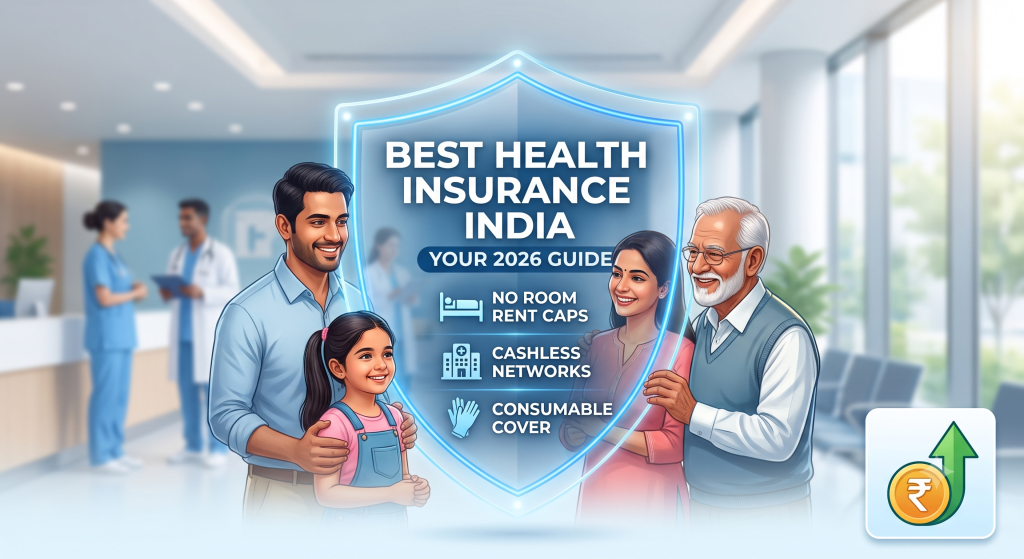
The Ultimate Guide to Choosing the Best Health Insurance Plan in India (2026)
How to evaluate, compare, and select bulletproof health coverage for you and your family without falling into hidden clause traps.
Key Takeaways: What Makes a Health Insurance Plan "The Best"?
- Avoid Low-Price Traps: Cheap policies often hide strict room-rent caps, copay clauses, and high sub-limits.
- Prioritize Cashless Hospital Networks: Choose an insurer with a strong network of cashless hospitals near your PIN code.
- Demand Restoration Benefits: Look for automatic restore features that trigger even on partial sum utilization and repeat illnesses.
- Eliminate Room Rent Capping: Ensure your policy has no room rent limit to prevent proportional deduction penalties across your entire hospital bill.
- Insist on Consumable Coverage: Pick plans that cover single-use medical items (gloves, PPE, syringes) to prevent unexpected out-of-pocket expenses.
Selecting the right health insurance policy in India can feel overwhelming. With dozens of insurance providers and hundreds of features to compare, many people end up making costly mistakes—either by picking the cheapest policy available or relying on plans with hidden restrictions.
A single medical emergency, critical illness, or major accident can deplete years of savings. Choosing a policy shouldn't be about finding the cheapest option; it must be about finding the most comprehensive coverage that pays out when you need it most without claim rejections or hidden out-of-pocket costs.
1. Why the "Cheapest" Health Insurance Policy Is Often the Most Expensive
When comparing health insurance policies, many people opt for a plan costing ₹8,000 per year over a ₹10,000 policy offering the same base cover (e.g., ₹10 Lakhs). While saving ₹2,000 upfront feels like a win, the cheaper plan often includes hidden restrictions:
⚠️ Hidden Restrictions in Cheap Plans
- Room Rent Limits (e.g., 1% of Sum Insured/day)
- Co-payment Clauses (10% to 30% self-pay mandatory)
- Disease-Specific Sub-limits (Capping treatment amounts)
- Excluded Medical Consumables (Out-of-pocket gloves, PPE)
📊 Real-World Scenario: ₹10 Lakh Hospital Bill
If a ₹10 Lakh hospital bill occurs, a restricted ₹8,000 policy might only cover ₹3 Lakhs to ₹4 Lakhs due to proportional deductions, leaving you to pay ₹6 Lakhs out of pocket.
Paying slightly higher premiums for complete, unrestricted coverage saves significantly more in the long run.2. Cashless Treatment & Network Hospitals
Health insurance claims generally fall into two categories:
The insurer settles the bill directly with the hospital. You only pay for non-covered items upon discharge. Zero strain on personal savings during emergencies.
You pay the entire bill upfront out of pocket, collect all original hospital bills and discharge summaries, and submit documents later to claim reimbursement (30-45 days process).
Before buying a policy, use online comparison filters to check the insurer’s Network Hospital List for your specific PIN code. Ensure top multi-specialty hospitals near your residence offer cashless facilities under that specific plan.
3. Recommended Sum Insured (Coverage Amount)
Healthcare inflation in India rises steadily every year (~12-14% annually). Having inadequate coverage renders an insurance policy ineffective during major health crises.
| Target Group / Individual | Recommended Minimum Coverage | Key Considerations |
|---|---|---|
| Children / Dependents | ₹5 Lakhs per individual | Focus on daycare procedures, accidents, and pediatric care. |
| Adults (Under 50 years) | ₹10 Lakhs minimum | Sufficient for major surgeries, critical illnesses, and high medical inflation. |
| Adults (Above 50 years) | ₹15 Lakhs to ₹20 Lakhs | Higher likelihood of age-related complications and prolonged ICU stays. |
4. Key Features Every Health Insurance Policy Must Have
To ensure maximum claim settlement and zero surprises during hospitalization, verify that your policy includes the following parameters:
A. Restoration Benefit (Refill Feature)
If one family member utilizes a large portion of the sum insured, the Restoration Benefit automatically refills the coverage amount for subsequent hospitalizations within the same policy year.
B. No Sub-Limits
A sub-limit caps the maximum amount an insurer will pay for specific treatments (e.g., capping kidney disease care at ₹2 Lakhs on a ₹10 Lakh policy). Always choose policies without disease sub-limits.
C. No Room Rent Caps
If a policy caps room rent at 1% of the sum insured per day, choosing a higher-tier room causes a proportional deduction on the entire bill (including doctor fees, surgery charges, and nursing fees). Opt for policies with No Room Rent Capping.
D. Short Waiting Periods & Pre-Existing Disease (PED) Coverage
Standard policies enforce a 30-day initial waiting period for non-accidental hospitalizations, along with specific waiting periods (1 to 4 years) for Pre-Existing Diseases (PED) like diabetes or hypertension.
- Full Disclosure: Always declare existing medical conditions honestly. Undisclosed PEDs lead to immediate claim rejections.
- PED Riders: Consider adding riders to reduce pre-existing disease waiting periods from 3–4 years down to 1–2 years.
E. Maternity & Day 1 Newborn Cover
For growing families, select plans that feature maternity coverage and Day 1 Newborn Coverage. Premature deliveries or NICU care costs can run into tens of lakhs; securing newborn coverage in advance covers these critical early risks.
F. Pre- and Post-Hospitalization Expenses
Medical expenses begin before hospital admission (investigations, consultations) and continue after discharge (medications, follow-ups). Ensure your policy covers at least 60 days of Pre-Hospitalization and 90 to 180 days of Post-Hospitalization expenses.
G. Day Care Procedures & Consumable Coverage
- Day Care Cover: Modern procedures (e.g., cataract, appendectomy, hernia) often require less than 24 hours of hospitalization due to medical advancement. Ensure your policy explicitly covers advance day-care procedures.
- Consumable Coverage: Non-medical items like gloves, masks, PPE kits, and syringes can account for 10%–15% of a hospital bill. Select plans or add-ons that explicitly cover medical consumables.
5. Super Top-Up vs. Restoration Benefit
When increasing your total health cover affordably, you may encounter Top-Up and Super Top-Up options:
Top-Up Plans
Apply deductibles on a per-hospitalization basis. They only trigger if a single medical bill exceeds the deductible limit.
Super Top-Up Plans (Preferred)
Apply deductibles to the cumulative total of all medical bills in a policy year. Far easier to breach deductible threshold.
Note: While a Super Top-Up is superior to a basic Top-Up, choosing a primary plan with an Unlimited Restoration Benefit remains the cleanest and most efficient way to maintain continuous coverage.
6. Additional Tax Benefits Under Section 80D
In addition to health security, purchasing health insurance offers tax savings under Section 80D of the Income Tax Act (under the Old Tax Regime):
| Category | Non-Senior Citizens (< 60 yrs) | Senior Citizens (60+ yrs) |
|---|---|---|
| Self, Spouse & Children | Up to ₹25,000 | Up to ₹50,000 |
| Parents | Up to ₹25,000 | Up to ₹50,000 |
| Maximum Total Tax Deduction | Up to ₹50,000 | Up to ₹1,00,000 |
Frequently Asked Questions (FAQs)
Q: What is the claim settlement process for online health insurance?
Online policies are issued directly by the insurance company. During hospitalization, present your digital health card, government photo ID, and policy details at the hospital's insurance desk to initiate cashless processing immediately.
Q: Does buying insurance online affect claim support?
No. Insurance policies bought online are directly serviced by the insurance company and network hospitals. Online aggregator platforms also offer dedicated 24/7 claim assistance teams to assist with claim processing and documentation.
Q: Can NRIs buy health insurance in India?
Yes. NRIs can purchase health insurance plans in India for themselves or their family members residing in India. Paying premiums via an NRE account may also qualify eligible policyholders for GST waivers on the premium amount.